

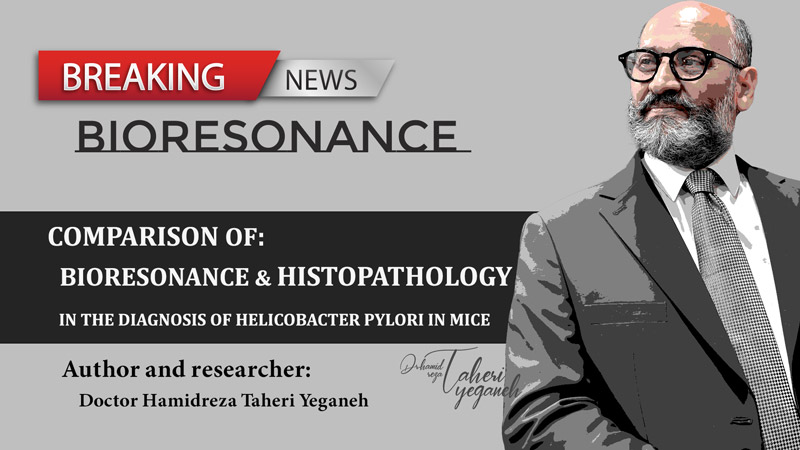
The main objective of this article is to compare bioresonance and histopathology for the diagnosis of one of the most common causes of gastric diseases (Helicobacter pylori). There are various diagnostic methods for identifying this bacterium, each with its own limitations. This study aimed to evaluate the accuracy of bioresonance (using a specific modulated frequency) compared to histopathology in diagnosing this bacterium in an experimentally infected mouse model
?What is Helicobacter pylori
Helicobacter pylori is a gram-negative, motile, non-spore-forming, often spiral-shaped bacterium that lives in anaerobic conditions in the sticky layer of the gastric mucosa and is known as one of the most important gastrointestinal pathogens in humans. This bacterium is known to cause diseases such as gastritis, gastric and duodenal ulcers, gastric cancer, as well as some non-gastrointestinal diseases such as cardiovascular diseases and migraine. Despite numerous diagnostic methods, limitations such as time-consuming, invasiveness, and low accuracy are observed in many of these methods
Bioresonance technology, as a new method, provides the possibility to identify the presence of bacteria in the body by analyzing specific electromagnetic waves. The aim of this study is to compare the ability of this technology with the reference method of histopathology for the diagnosis of Helicobacter pylori in an animal model
Comparison of bioresonance and histopathology in the diagnosis of Helicobacter pylori
This experimental study was conducted on 100 male SPF mice of C57BL/6 strain, aged 6 to 8 weeks and weighing approximately 25 to 30 grams. After ensuring that the mice were not initially infected with Helicobacter pylori, the animals were maintained under standard conditions and randomly divided into two groups of 50 (control and treatment). After being prepared with sodium bicarbonate to reduce gastric acidity, the mice in the treatment group were inoculated intragastrically with the standard strain of Helicobacter pylori
On days 0, 7, 14, 21, and 28 after inoculation, both diagnostic methods (bioresonance and histopathology) were used to examine the infection. In the bioresonance method, the MINI-EXPERT-DT device with a specific frequency and amplitude was used
In the histopathology method, after gastric tissue sampling, the samples were prepared and examined microscopically with hematoxylin-eosin and Giemsa staining. The data were analyzed with SPSS software and the chi-square test, and a P value of less than 0.05 was considered significant

Results obtained from bioresonance and histopathology methods
On day 0, only bioresonance was able to detect infection in 60% of the mice in the treatment group, while histopathology was negative at this stage. On day 7, bioresonance detected all infected mice, but histopathology was positive in only 20% of cases. From day 7 to the end of the study, bioresonance was able to detect infection in all cases (100%), while histopathology detected all infected cases only on day 28. The statistical difference between the results of the two methods on days 0, 7, 14, and 21 was significant (P<0.05)
Bioresonance is the best method for diagnosing Helicobacter pylori
By comparing bioresonance and histopathology, bioresonance was able to detect Helicobacter pylori infection more quickly and with greater sensitivity than histopathology. The limitations of histopathology, including dependence on the sampling site, bacterial density, and morphological similarity to other bacteria, can affect its efficiency. In contrast, bioresonance, by utilizing specific frequencies, is able to act as an accurate, rapid, and noninvasive method. These features make bioresonance a potential tool for screening and diagnosing infectious diseases, especially in the early stages
Conclusion
The present study is the first attempt to use bioresonance technology in the diagnosis of Helicobacter pylori in an animal model. The results obtained show that by comparing bioresonance and histopathology, this method has higher sensitivity and specificity than tissue pathology and can be considered as a complementary or alternative method for rapid, inexpensive and non-invasive diagnosis. It is recommended to conduct additional studies on other pathogens using this technology
Acknowledgements
The authors express their gratitude to Dr. Hamidreza Taheri Yeganeh, the father of bioresonance science in Iran